
Collecting and storing water is a concrete step toward freedom: what was actually done at the Applied Ecology Centre Autosufficienza
Francesco Rosso | Founder and Caretaker of the Autosufficienza Centre
In 2009, after years of research, we finally purchased the land on which the Autosufficienza Farm now stands.
We had long been looking for a place where we could become resilient, ready for the changes and challenges that would arise in the years to come.
We were aware that, as a Western human species, we were becoming increasingly fragile: for roughly 300,000 years we were self‑sufficient regarding water, food, shelter, heating, and health, thanks to what the surrounding environment provided. In recent decades, however, we have become completely dependent on a small handful of multinationals that now supply virtually everything we need to survive.
Cities such as Dubai and Las Vegas, promoted worldwide as models to emulate, are among the most ill‑prepared for any type of crisis.
The constant threat of economic, financial, energy, and environmental crises led us to imagine a place of self-sufficiency where we could be independent from “the system” and guarantee, for ourselves and future generations, survival even in the event of various catastrophes.
Without water there is no life
During the search for the place where to build our self-sufficiency one of the essential requirements was the presence of quality spring water.
Human beings and all living creatures are made up of at least 70% water. The Earth itself, seen as a living being, respects this parameter and is 70% covered by water. However, 97% of this water is salt water. Of the remaining 3%, 75% is fresh water trapped in glaciers and a further 12% is found at over 700 metres depth.
The water in lakes, rivers, aquifers and in the atmosphere available for human beings and most terrestrial living beings is 0.375% of that present on the planet. Clean fresh water is the greatest wealth one can have.
The objective of clean water led us to search at altitude: unfortunately when you are at a low level there is almost always someone polluting above you.
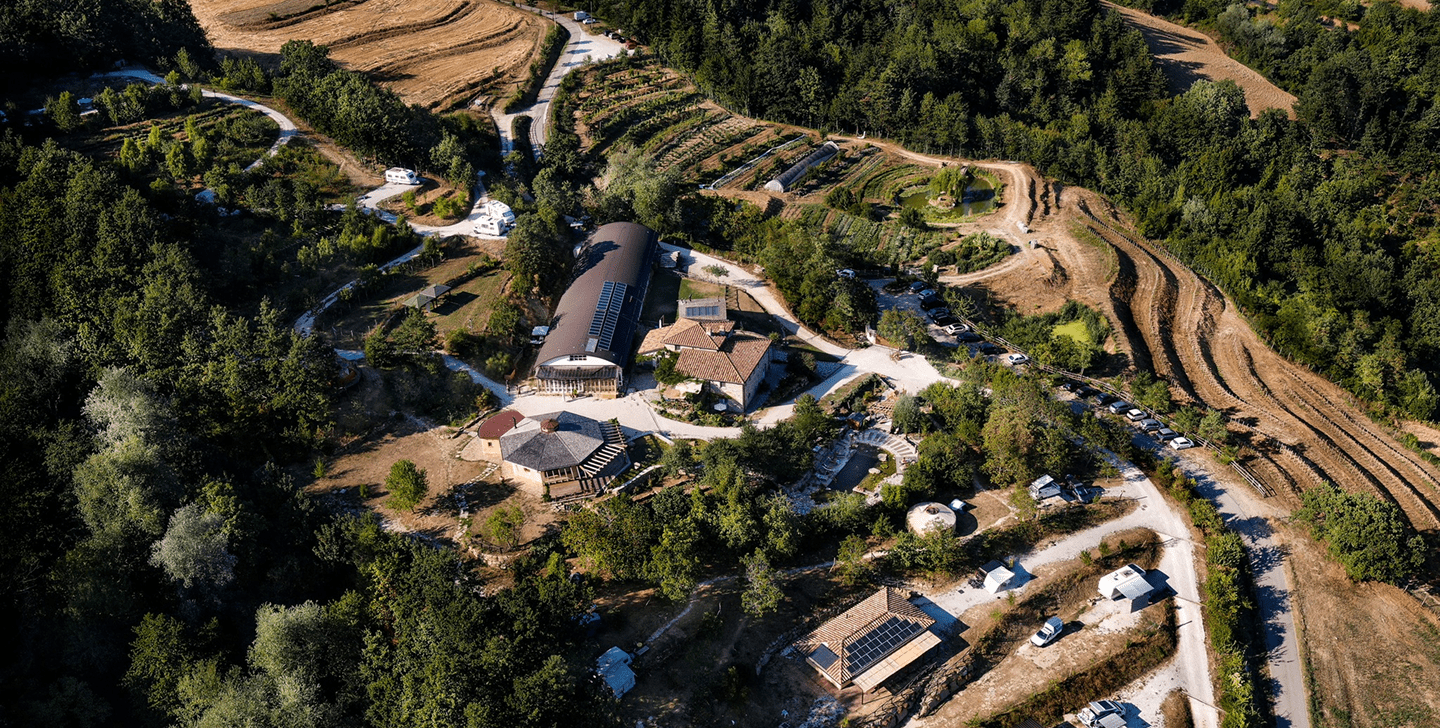
Having arrived at Paganico di Bagno di Romagna in the province of Forlì Cesena, at 700 metres above sea level, we were shown a farm that had been abandoned for 50 years from a residential point of view and for over 20 years from an agricultural point of view.
All the buildings were collapsed and dilapidated, there were no interesting infrastructures, there were no fruit trees, there were no lakes or streams that would guarantee water all year round, but there were natural springs of pure, quality water.
We decided that this place would become the change we wanted to see in the world.

The water when it’s not needed
At Autosufficienza Farm, as in many parts of Italy, it rains a lot during the colder months, when water is needed less and very rarely during the summer months, when we have great need of it. From the early years we realised how in the driest summers the streams dried up completely and the springs captured upstream were not sufficient for agricultural uses.
The knowledge of permaculture and in particular that put into practice by Sepp Holzer – the rebel farmer who has a thriving farm in the Austrian Alps and who will become one of the reference models – made us immediately understand that we would have to invest a lot of energy, in the years to come, to collect and conserve water.
Investing in water (and therefore in life) for seven generations
Today everyone is looking for recipes and advice that offer immediate solutions to the drought and growing infertility affecting a large part of Italian land. Immediate solutions always see water and soil fertility as an event produced from outside, very often they appear economical in the short term, but are extremely costly in the long term.
Our choice was to invest for the next seven generations and, even at the expense of immediate advantages, to reason about the impact of our every action, so as to build wealth and beauty for those who will inhabit these places after us.
For permaculture water, like every indispensable resource, must be supported by multiple elements: with this in mind we analysed everything that was possible to do to collect and infiltrate as much of it as possible into our land.

Practical interventions on the Farm
- Swales
One of the very first works was the creation of 2.2 kilometres of swales (contour ditches) in the extensive arable fields where we grow ancient cereals, pulses and seeds. Unlike drainage ditches which channel water to transport it quickly away from the land, the swale collects and infiltrates water slowly into the ground, recharging the water table. By spacing swales close to one another along the slope we also enormously reduce surface erosion, as the water can never gain speed.

- Collection basins
Following the visit to Sepp Holzer’s Krameterhof, astonished by the beauty and productivity that this man had managed to create in a completely inhospitable place and climate, also thanks to his initial consultancy, we began to terrace the land surrounding the farm centre and create natural water collection basins, namely without the use of liners or concrete.
We had already tried in the past to create basins by digging the ground in some damp areas or that in any case seemed to us could collect water, but with disappointing results. The neighbours confirmed to us that, given their previous experiences, in these lands it was not possible to collect water without the use of cement or plastic.
When we posed the problem to Sepp Holzer he replied that he had created lakes all over the world without cement and plastic, in any climate and soil without failing and that certainly we would not be the first.
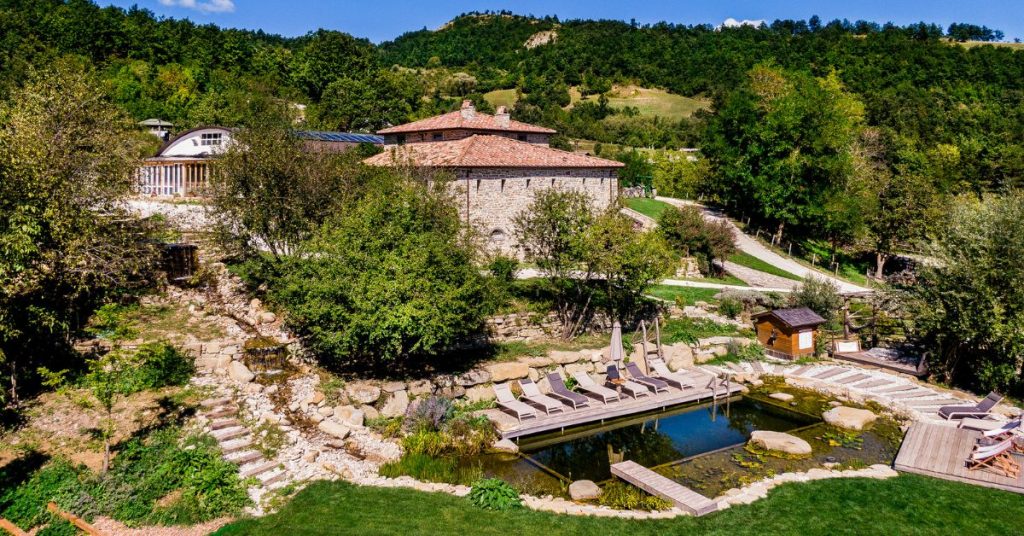
And so, in 2018, the first two natural basins of the farm were created, followed by others in subsequent years. These are wonderful bodies of water that immediately filled with life: frogs, newts, water snakes, dragonflies, birds flocked from everywhere to settle in the new home and enrich the farm with biodiversity.

- Terracing
Even before Sepp’s arrival we had begun to terrace the land surrounding the farm centre: having learnt with him the technique to do them safely and to a high standard, over two hectares were terraced in a few years. Terracing and lakes require significant energy expenditure in the initial phase. They are created with a heavy excavator which clearly consumes diesel, pollutes the atmosphere and radically modifies the soil. For this reason not everyone who has a natural farming approach is in favour of this type of intervention.
The main reason is that they think in the short term and not across seven generations. If they considered amortising the initial environmental and economic costs with 300 years of soil regeneration and water collection, the initial investment would become insignificant.
We had very steep and very eroded land near the farm centre that was unable to infiltrate water and retain organic matter. Land that became poorer every year. Today the terraces, in addition to becoming enriched every year with organic matter and collecting a large quantity of water, have become super productive thanks to a polyculture unthinkable before the interventions carried out, which sees fruit trees and berries on the edge of the embankment, aromatic herbs on the embankments and vegetables on the terrace.

- Rainwater collection
The gutters of the farm buildings channel the water towards storage tanks and the overflow reaches a collection basin, so that 100% of the rain that falls on over 1,500 square metres of covered surface is not dispersed. The water from the road ditch has also been channelled into the basin, so that it too can contribute further to water collection
- Treatment and reuse of grey and black water
The black and grey water from the structures following a phytopurification process (filtration with gravel, plants and bacteria) not only do not risk polluting the land and aquifer, but are even recovered in a downstream basin used for irrigating a vineyard and several surrounding areas.

- Intercepting springs
When we noticed a road in the woods upstream that was collapsing, we followed the water in September, the driest month. We managed to capture the spring at the rock and thus we found the supply for another collection lake that we had created in the past, but which tended to dry up during summer.
- Mulching and organic matter
The way we cultivate also contributes to retaining as much water as possible in the soil. Keeping the soil covered as much as possible with vegetation, with abundant mulching and addition of organic matter contributes to collecting water, as well as limiting evapotranspiration. Various studies demonstrate that soil with only 2% organic matter can reduce the need for irrigation by 75%, compared to poor soils in which the quantity of organic matter is less than 1%.
The combination of these solutions leads us to collect enormous quantities of water in the basins, in the tanks but also in the soil and in the aquifer which, in exceptionally dry and hot years such as 2022, proved providential.

Collecting and storing water is a concrete step towards creating a paradise.
This article was featured in the magazine Vivi Consapevole 70 (September/November 2022).