
How I renovated La Fattoria dell’Autosufficienza, learning from great examples and great mistakes
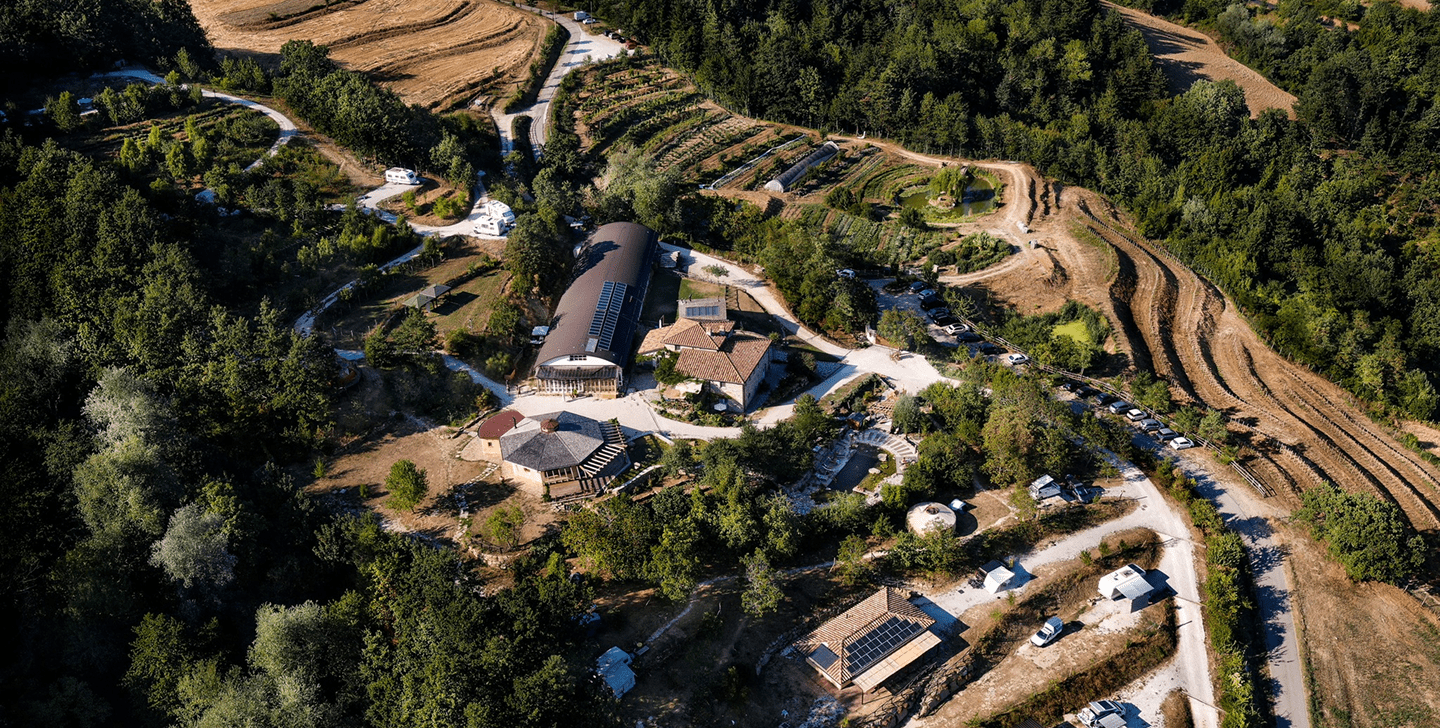
I was 24 years old when my family and I decided to purchase, in the mountains, 70 hectares of abandoned land and approximately 1,500 square metres of dilapidated buildings, many of which were covered in asbestos. My experience in construction was, at that time, zero. I had no idea how a plumbing system worked, how to insulate a house, about heating and cooling methods, how to produce energy, choose fixtures. The only thing I was certain of was that I would rebuild everything using only natural materials, consistent with our family choices, always oriented towards natural health and organic food and, for many years, macrobiotic.


Starting from zero: training
After attending a 72-hour permaculture course, where I learnt interesting knowledge, I was attracted by two courses that, at the time, the PAEA association organised and which were held respectively in Germany and in the United Kingdom. Accompanied by Paolo Ermani, president of PAEA, I had the opportunity to spend a week at EUZ, the German Energy and Environment Centre. During those days we visited public structures, companies and private homes which were of great inspiration to me. Engineers and architects showed us how it was possible to build an energy-saving or even passive structure, namely zero emissions. I had the opportunity to compare various methods for heating a building and to learn about the fixtures available on the market, insulating materials, alternative energies, water purification. Having returned from the course I was enthusiastic about starting the renovation, but I didn’t find any experienced local technician who could follow me. I began to look for an architecture studio to be able to put on a map my idea of the entire renovation and conversion project of the structures into a centre for applied ecology. I changed three of them, one more disappointing than the other. I couldn’t transfer my idea of natural buildings that would integrate perfectly into the environment, with forms as non-linear as possible. I had recently seen the works of Friedensreich Hundertwasser and I found myself perfectly in tune with his thinking when he maintained that “the straight line is godless, modern architecture needs to be cured”.
Learning from mistakes: the external renovation
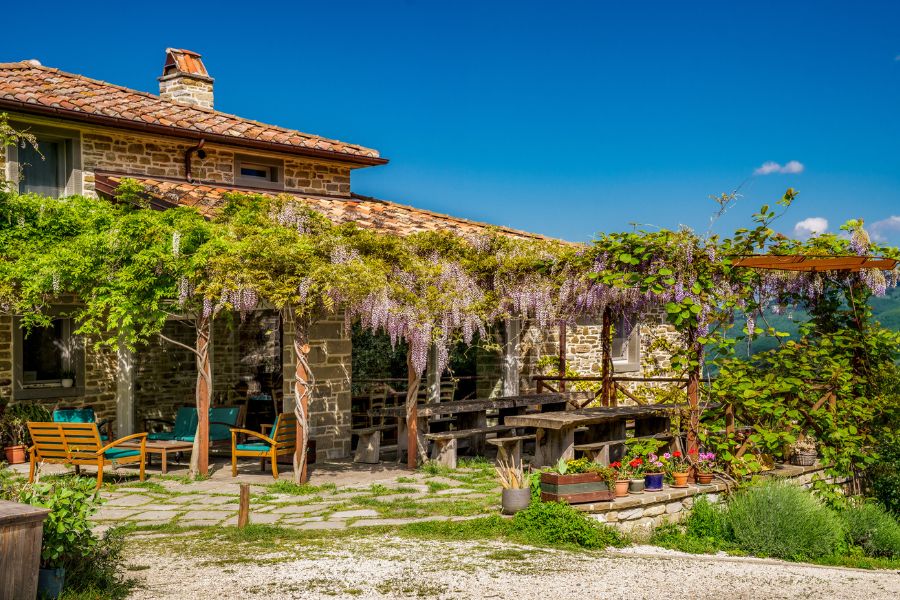
Without a master plan the renovation of the stone ruin began anyway with the consultancy of a local surveyor and the surveyor Luigi Foschi who had recently specialised in wooden and energy-saving houses. The building we had to work on had historical landscape protection, so initially we were quite limited in choices. We couldn’t demolish and had to start from the rather tragic situation in which it found itself. I also added two constraints: we would use only natural materials and create an energy-saving structure that could become an example. After various quotes I entrusted the masonry work to a local company that the surveyor recommended to me. Seeing the walls rise was super exciting, it took six months to get to the roof. We used only local stone and hydraulic lime. The hydraulic lime cost five times more than the cement lime normally used, but I learnt that this way the walls would breathe, I would avoid internal humidity and any fumes from toxic materials used in the cement. I then discovered that buildings without cement transmit a completely different energy and are much more liveable. The roof was bound to wood and tiles so it remained to decide how to insulate it. The choice was to use a 20-centimetre wood fibre package at three different densities as well as ventilation, to be certain of being well insulated, both in winter and summer. Only after the walls and roof were finished did we start to think about how to do the systems. This was a very costly mistake, because it forced us to make channels in the walls we had just built and stone is not famous for its softness. I learned from my own experience that it is essential to know from the outset how the house will be heated, where the electrical systems, plumbing systems, controlled mechanical ventilation systems and toilet vents will pass, which for some strange reason one always forgets to consider, until the plumber arrives (this is a mistake we managed to make twice).


How we insulated the building
After what I had learnt in Germany it was clear that despite the 50 centimetres of stone wall I would have to insulate the walls with insulation to have an energy-efficient structure. Not being able to act from the outside due to the historical-landscape constraint we decided to do an internal cladding, less efficient, but still effective. The choice of material was not obvious. We were faced with an irregular stone wall and a high risk that condensation would form between the cold external stone wall and the insulation we would use. So the choice fell on lime-hemp which offered, in addition to an excellent thermal standard, the guarantee that condensation would never form between the two walls. And so the lime-hemp was sprayed by means of a special pump directly onto the walls by the only Italian company at that time offering this service, Equilibrium which later became Tecnocanapa.
For heating we decided to use the most efficient system we knew, microcapillary radiant ceiling or wall. With hindsight the choice of microcapillary radiant was not right for our context. The radiant system works at very low temperatures (on average 28 degrees) with great energy efficiency, but it sits poorly both with the wood boiler, which produces high temperatures, and with the discontinuous use of the structure which requires heating the environment in relatively short times. However, it is certainly a perfect system for a structure that is powered by a heat pump or fossil fuel (methane or LPG) where it is possible to easily regulate the water temperature. The choice of wood and an efficient reverse flame boiler was however inevitable, considering the 30 hectares of coppice woodland we own.
Interiors: stove, flooring and furnishings
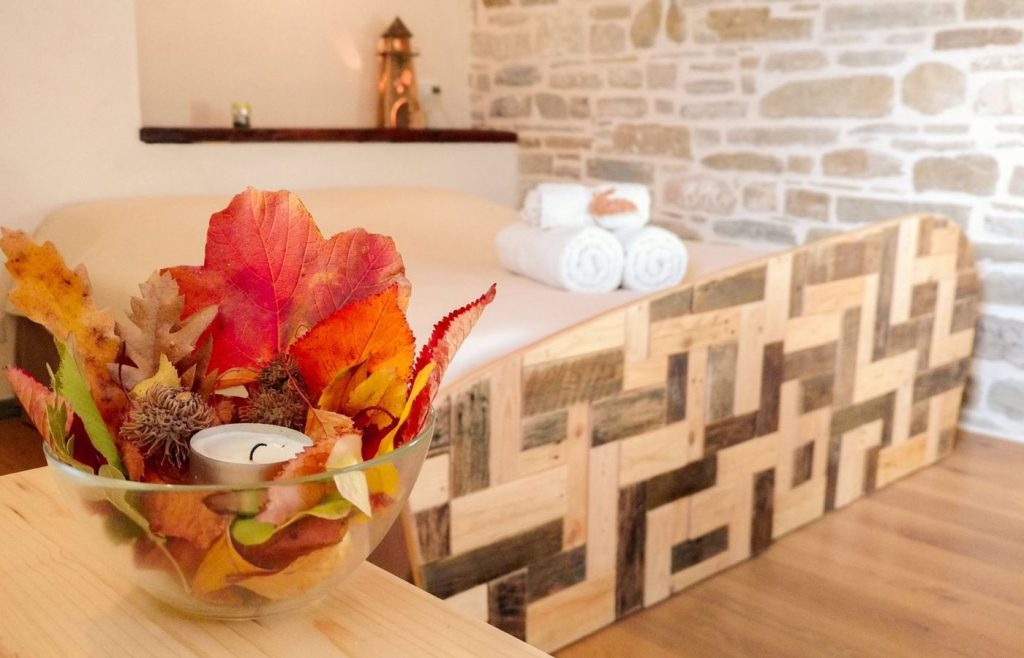
For the main hall we decided, in addition, to create a large thermal mass stove which was entrusted to Francesca and Andrea of Filo di Paglia. Since then the two architects have worked at the farm for several months a year every year, sometimes as artisans and natural builders, other times as architects, finally able to develop and realise my thinking into concrete projects and buildings. The thermal mass stove, made with 3,000 kilograms of refractory bricks, has proved to be a work of art that attracts the attention of all the farm’s visitors. After the stove Andrea and Francesca also took care of the finishes and in particular the beautiful plasterwork. They managed to give movement to the linear forms of the old building and we chose to use lime-hemp also as finishing plaster without any paint applied. In some parts the choice also fell on earth (clay) plasters then decorated. To conclude we installed wooden fixtures treated with Auro natural paint, beautiful, with the limitation that externally they require a lot of maintenance, as the roof has little overhang and does not protect them sufficiently. For the floor there was no doubt, floating wood (without glue) and treated only with oil thus avoiding varnishes and toxic materials. The furniture was entrusted to a local craftsman, Ecospazi, who with wood was able to recreate soft and natural forms.


Water management
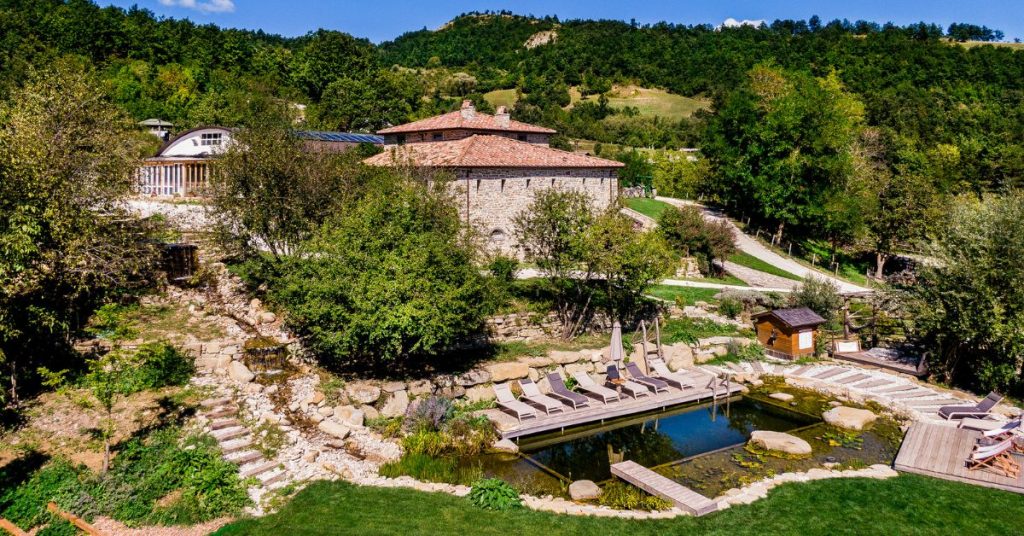
Having finished the interior when I thought I had finished another important phase began, the management of clean and dirty water. The water from the roof is recovered in a cistern, then used for irrigating the flowerbeds, whilst the dirty water after passing through the septic tank ends up in our phytopurification basin: a large tank filled with gravel and plants. Through the mechanical action of the gravel and the biological action of the bacteria that the plants develop in their roots we have at the tank outlet completely odourless and colourless water, 99% purified. In this way we are certain not to pollute the aquifer. The result, after two years of work, is a super warm and welcoming structure: anyone with a minimum of sensitivity is able to perceive great positive energy, liveability and wellbeing there. All guests enter barefoot and after a few minutes feel at peace and relaxed.
The temple and campsite facilities in straw bales
After several years in which we carried out smaller projects – including dry stone walls, artistic earth walls, raw earth oven, canopies and small renovations – in 2019 a second important step of the master plan created together with Filo di Paglia began to take shape. For the yoga hall and for the farm camping facilities we chose to build super efficient structures in straw bales, Andrea and Francesca’s speciality. Contrary to what one might have imagined, the municipality of Bagno di Romagna welcomed this construction method with satisfaction. After entrusting a specialised company with the foundation and wooden structure, we proceeded to lay zero-kilometre straw bales, a waste material from wheat harvesting. Immediately afterwards the friends from Tecnocanapa arrived again who encapsulated the straw bales in lime-hemp to avoid risks of contact of the straw with fire, water, insects, animals, factors that could prove fatal for this type of material. Moreover the lime-hemp makes the surface more uniform for the application of plaster and further insulates also giving greater mass inside, an important factor to be able to maintain warmth in winter and coolness in summer. In these buildings we chose to simplify the systems part as much as possible: no VMC (mechanical ventilation), no wall or floor systems, no electronics. The main hall is heated thanks to a thermal mass stove similar to the one already created in the stone structure and cools naturally. As was done thousands of years ago, at the highest point of the building there are windows which, if opened, let the hot air escape. When the hot air exits from the top, a depression is created in the hall. The air is then naturally introduced through vents placed on the wall and connected to underground pipes that reach the adjacent woods. The air from the woods is already cooler, further cooling then occurs by passing for 35 metres underground and so inside the building one breathes fresh air, but not conditioned air. Here too the fixtures are wooden, but to avoid the maintenance problems encountered in the main building we acted with a 1.5 metre eaves overhang that protects the fixtures from above. The finishing solutions recall the previous building, but with further elements such as for example the beautiful bathrooms made in cocciopesto, an ancient Roman waterproofing technique. The final result, particularly of the octagonal hall, is an extraordinary work of rare beauty.
Looking to the future
We can build healthy buildings, with natural materials and high energy efficiency. Today the construction industry that attempts to pretend to be efficient proposes concrete walls, polystyrene insulation, PVC fixtures and heat pump heating. All artificial, all with enormous environmental costs during production and disposal. It closely resembles the pharmaceutical industry’s proposal for human health: polluted food, vaccines, medicines and medicalisation for life. All artificial, all with enormous environmental costs for production and with catastrophic implications for the human species, increasingly weakened. The current industrial model does not encourage reflection on the long term, but always and only thinks about the present. In designing the farm, we thought of architecture that could have a life equal to seven generations: we expect that these buildings, present and future, marry perfectly with the surrounding environment, are made with natural materials as present on site as possible, offer true comfort also thanks to the energy of the materials used and are almost entirely “biodegradable”. What truly does good for humanity, also does good for the environment. Here at the Farm we have chosen to build the change we want to see in the world.
Written by Francesco Rosso. This article was featured in the magazine Vivi Consapevole 65, June/August 2021.