
Relationship as a key element in Permaculture design
Permaculture was born as a land design system that harmoniously integrates man with the environment and its elements, namely dwelling, food, natural resources, human and social relationships. The objective is to design lasting settlements, as similar as possible to natural ecosystems, through the recognition, use and harmonisation of landscape components (morphology, climate, soil, water, vegetation, animals), developing relationships of mutual support between environmental elements and people’s needs.
Design and self-sufficiency
“Thinking in a design way” and “self-sufficiency” therefore become the fundamental starting point, together with the development of good observation skills, which are not limited to “seeing with the eyes”, but also to analysing the landscape, understanding its limits and resources and what the interactions are between already existing elements. As David Holmgren, co-founder of Permaculture, writes: “Good design depends on a free and harmonious relationship with nature and with people, in which careful observation and thoughtful interaction provide the design with inspiration, repertoire and models”. To analyse the relationship between the various elements in a Permaculture design it’s important to understand that everything is interconnected, that every element in a system performs multiple functions and that every function can be performed by multiple elements. Let’s take for example the chickens on our farm:
- they provide us with fertiliser that we then use in the vegetable gardens or in the orchard, transforming kitchen scraps into compost;
- they are free to scratch around and therefore fertilise some areas of the farm, where they also offer the service of grass mowing and insect control;
- they provide us with eggs and meat;
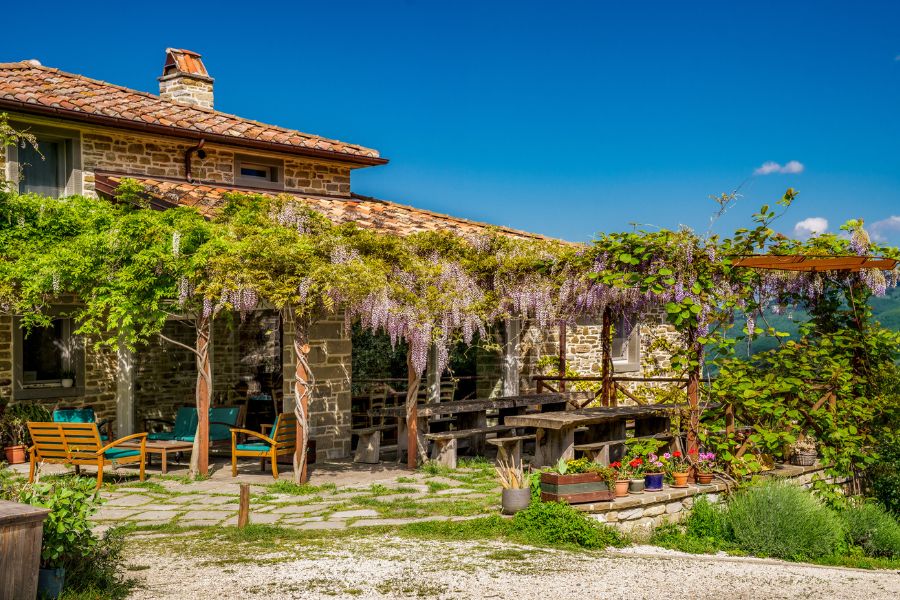
- they are a great attraction for guests of the agritourismo.
At the same time the functions they perform can be partly performed in another way making the farm more resilient. For example compost also comes from other animals that live on the farm, or from the maceration of wood chips or kitchen scraps not suitable for animal feed.


Design by sectors
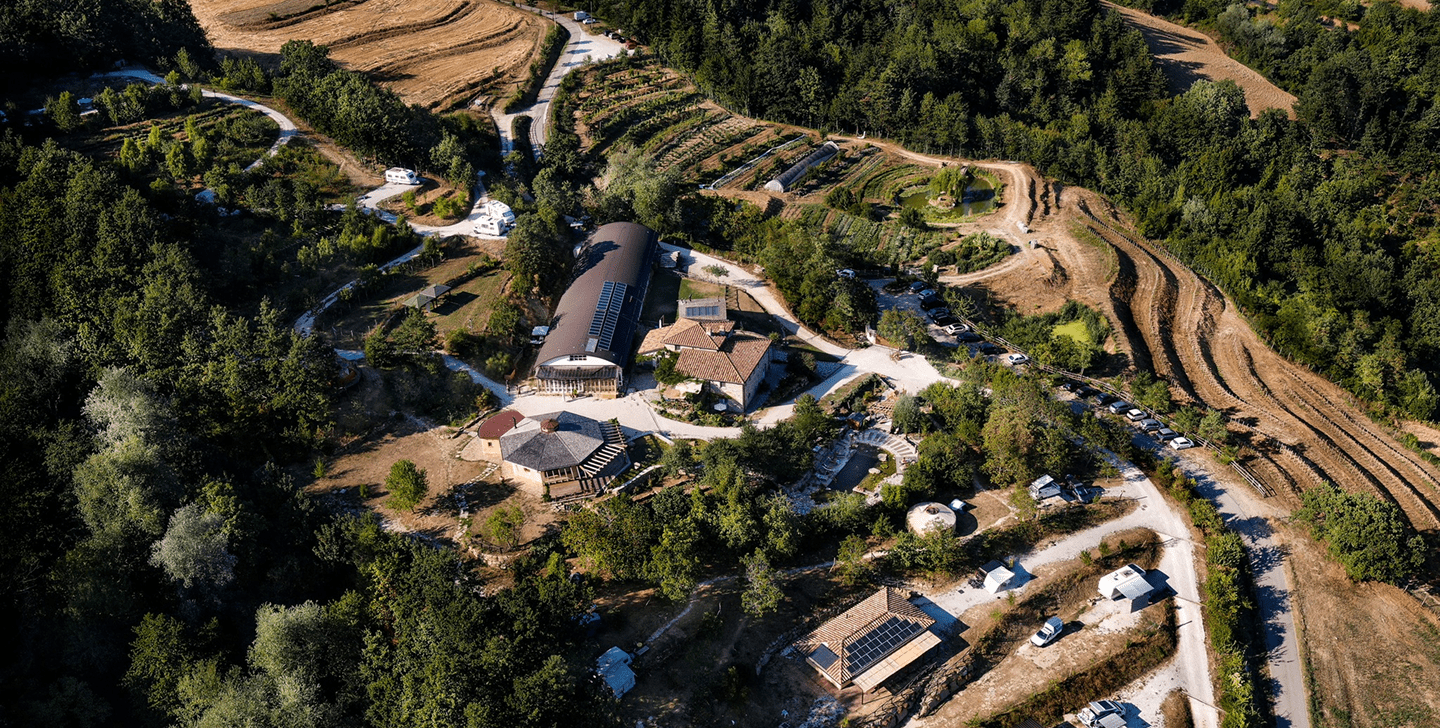
The analysis of landscape zones and sectors is a first step to create patterns that help optimise energy consumption, taking into consideration the time and energy used to deal with each element, the proximity of the various elements and the people who take care of them. One starts by considering the landscape as a series of zones, at the centre of which is the business part or dwelling (“Zone 0“). The placement of elements in each zone will depend on the importance, priority and number of visits necessary for each element. A herb and salad garden, for example, will be located near the kitchen access, namely in “Zone I“, the one immediately around the house. In “Zone II“, instead, we will have the most intensively cultivated and mulched vegetable gardens and some animals such as chickens and rabbits, whilst in “Zone III” other animals such as sheep, goats and pigs and trees or shrubs. In Zone IV we will have, for example, firewood trees and a food forest, to conclude with “Zone V“, represented by an uncultivated part of trees and shrubs which also serves as an ecological corridor for wildlife.
On the farm we have often made mistakes in zone management, which we soon noticed. For example initially we had the chickens not too close to the farm centre and moreover in a sunny area so in summer we had to protect them from the sun and in winter we had great difficulty visiting them, especially with deep snow. This situation required us so much time and energy that we could have dedicated to something else. Another similar mistake was to establish a low-maintenance orchard in an area very close to the farm centre. We soon realised that that area would be much more productive as an agricampeggio as it was easily connected to utilities, near reception and with an excellent view. It’s increasingly clear to us how every part of the business is connected and can benefit or not from proximity to the farm centre, to the lake, to utilities, to the woods etc. Careful placement within the space can be an enormous saving in terms of costs and energy. Not having time and energy to manage the entire surface of the farm, 700,000 square metres, the choice was to dedicate over 50% of the surface to “Zone V”, represented by woods.

Sector analysis
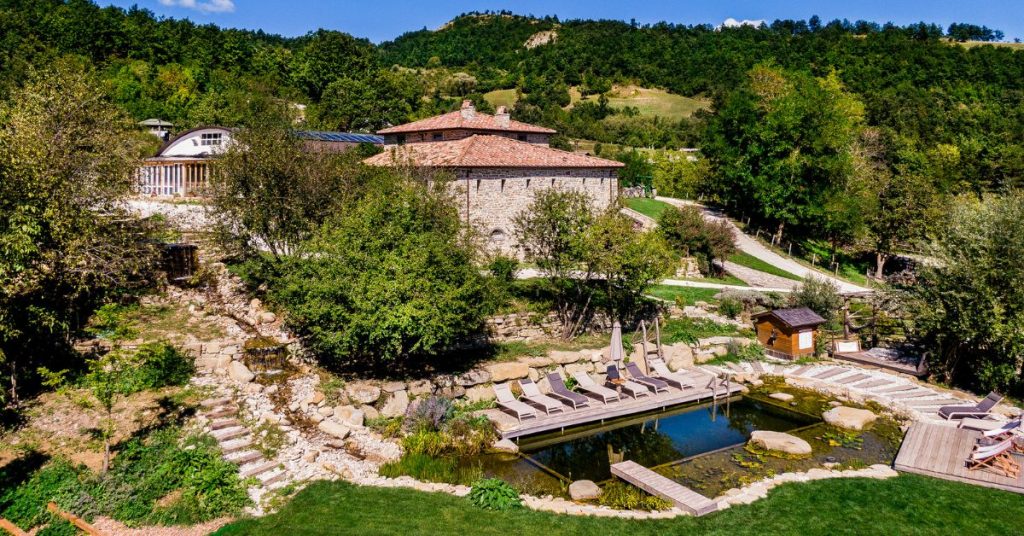
The objective of sector design is also to channel external energy sources (wind, sun, fire and water) towards or outside the system. It’s essential to determine risks, but also to identify and design microclimates. We will therefore place elements (structures, particular plant species etc.) in a sunny or, on the contrary, shaded area depending on their needs and functions. This has the advantage not only of increasing the energy efficiency of elements, but also of creating systems that need as little human work and maintenance as possible. Finally, sector analysis and the creation of microclimates allows the cultivation of a greater variety of plants and favours the biodiversity of the system, also exploiting the so-called “edge effect”, namely greater soil fertility and richer fauna precisely where two microsystems meet. The main application difficulty we have encountered on the farm is the strong wind from the South. Having a predominantly cold climate, we are pushed to have to create warmer microclimates and therefore seek South-facing exposure, which however is the one that exposes plants and buildings to greater wind stress. So then we need to start identifying hollows, shelters provided by walls or simply by the woods which also at the back provide a windbreak effect. The most rewarding experiences to date have been the creation of dry stone walls and terracing which allow us to create decidedly favourable microclimatic areas. In the coming months we will finally be able to proceed with the creation of water basins which will allow us to create further edge zones, warmer microclimates and an infinite increase in beauty and biodiversity.

The ethical and human component
Permaculture has within it a very strong ethical component, going so far as to also embrace the theme of human relationships and becoming central in the development of a de-growth culture. Amongst its principles in fact, in addition to that of taking care of the earth, there is also that of taking care of people (looking after oneself, relatives and the community) and sharing equitably (setting limits on consumption and reproduction, redistributing surplus). Permaculture has as its main objective that of allowing individuals, families and local communities to accentuate their self-sufficiency and self-regulation, reducing total environmental impact, transforming society and reorganising the production-consumption cycle. On the farm we constantly host courses on self-sufficiency and give many people the possibility to have a volunteering experience to learn self-production techniques and consumption reduction.