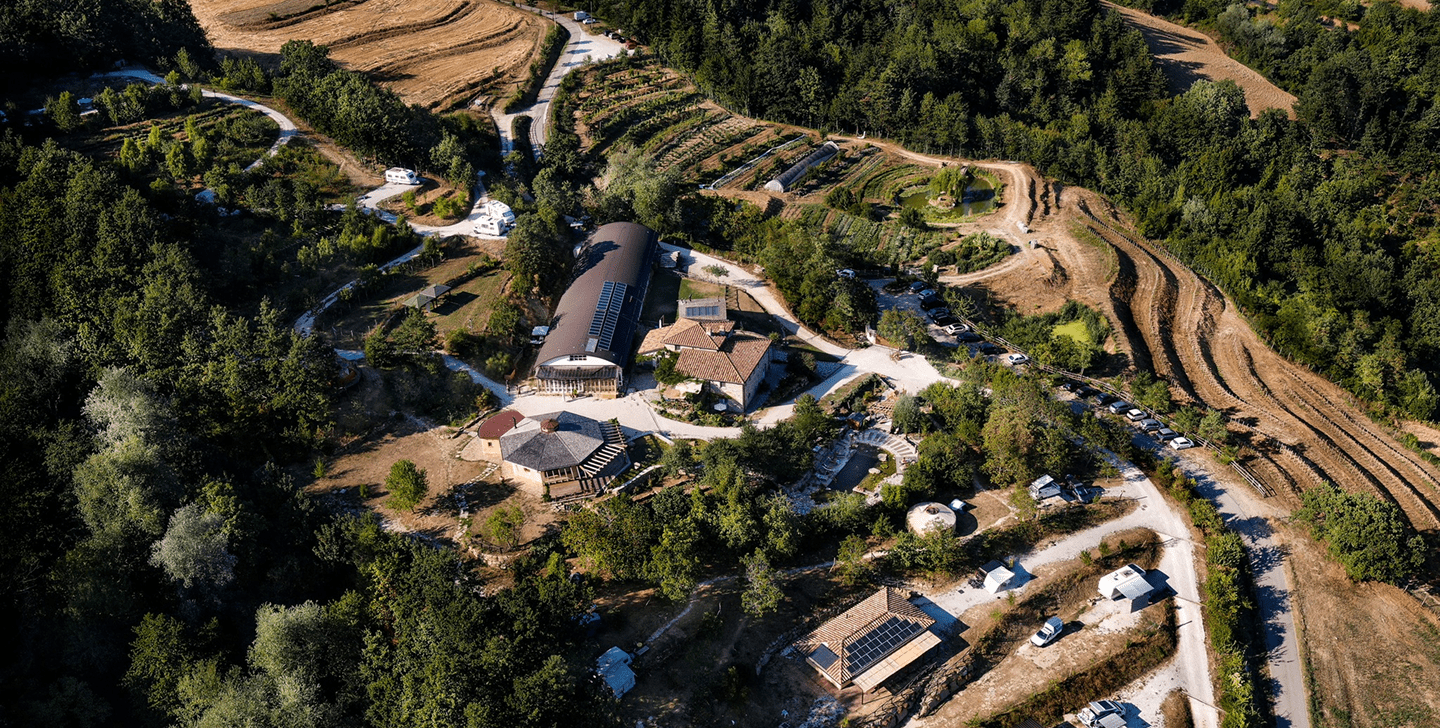



When the Autosufficienza project was born in 2009 the place had not been inhabited for fifty years and the land had not been cultivated for twenty years. There was no usable covered space. In 2010 to have a minimum base of support we built a compost toilet (dry toilet) and ordered a yurt directly from Mongolia through Silent Breeze (a company no longer operating). The yurt is the typical dwelling of the Mongolians but also of other neighbouring countries who by nature are nomadic and usually move every 6 months. It is an easily assembled and disassembled structure comparable to a tent but with the advantage of having excellent insulation which is traditionally felt (hair from sheep, goats, camels, yaks, etc.).

The first yurt, made self-sufficient thanks to a photovoltaic panel, a micro wind turbine, a gel battery and a small wood stove, was initially a multifunctional space where we slept, ate and held courses, then became the dormitory for wwoofers (volunteers) and finally today has become a room for guests of the farm camping.

In 2021 in the agricampeggio, again dedicated to guests, a new yurt arrived, this time Made in Italy (laleggera140.wixsite.com/my-site). Compared to the original yurts it is higher, more robust and brighter. As insulation instead of felt hemp was used, more suited to our climate especially to winter humidity.
Unlike traditional yurts where the fabrics are multiple overlapping pieces held in place by ropes tightly pulled around the circumference, the external sheet is a single piece and is screwed at the top to the circle, to the platform and on all the edges of the fixtures. This guarantees greater safety in case of strong winds. Moreover externally there are no ropes which wear the fabric a great deal, the only structural holding rope is a stainless steel cable which contains the wooden structure and passes inside.

The farm’s yurts have essential furnishings, with untreated wooden flooring, LED lighting and 4 and 6 beds respectively. They do not have a bathroom which is in a separate structure.
What permits are necessary to install a yurt?
The same as needed to put up a tent if you don’t make foundations, masonry works or permanent connections. Each municipality has different legislation on the possibility of positioning tents in private, agricultural areas, etc.

Where is it possible to purchase a yurt?
The ever-growing demand has meant that supply has also grown in Italy. On the internet it is possible to find various sellers, some produce whilst others import. With Diego Carletti (laleggera140.wixsite.com/my-site) we got on very well. He also provided us with assistance to renovate the old yurt which after 10 years needed a bit of maintenance.
How much does a yurt cost?
The price changes depending on the diameter, origin, number of fixtures, finishes, etc. To give an indication the first yurt that we purchased in 2010 with a diameter of 6.5 metres cost 5,000 euros. The second purchased in 2021 with a diameter of 5 metres cost 7,500 euros. In the last year prices have increased further. The need to create a platform on which to place the yurt must also always be considered. We have always self-built it on stilts in chestnut and larch wood with an indicative cost of 1,000 euros.
What maintenance work is necessary?
During winter it would be good to light the stove from time to time, especially when it is cold because felt suffers greatly from humidity. Every 3-4 years it is necessary to replace the external UV protection sheet.