


How We Create Beauty, Quality Objects, and Useful Processes from Materials Considered Waste
Tommaso Carmenati | caretaker at the Applied Ecology Centre Autosufficienza
The core theme is always the same: imagination. As long as we believe only a limited range of options is possible, we will never be able to consider alternative paths beyond those already taken.
At the Applied Ecology Centre Autosufficienza we strive to make manifest the change we would like to see in the world through concrete, replicable examples so that anyone who chooses to visit us—whether for a course or a vacation—can draw inspiration from virtuous models and expand their own imagination.
That is our main contribution to the common good: when you see tangible examples of communities trying to live in a healthier, more ethical, and environmentally respectful way, you’ll know that path is achievable. This dramatically broadens your personal freedom of choice. Day by day, this is how we commit ourselves to building a better present and future.
Focusing primarily on ecology and sustainable lifestyles, one of the topics we give particular attention to is waste management. In this article we will share some “anti‑waste” strategies that, besides being highly useful, demonstrate that beauty can be created from what is constantly present in nature yet often overlooked. Technology and nature can be perfectly integrated; all it takes is a pinch of creativity and imagination.


Don’t tell me you’re wasting the wood
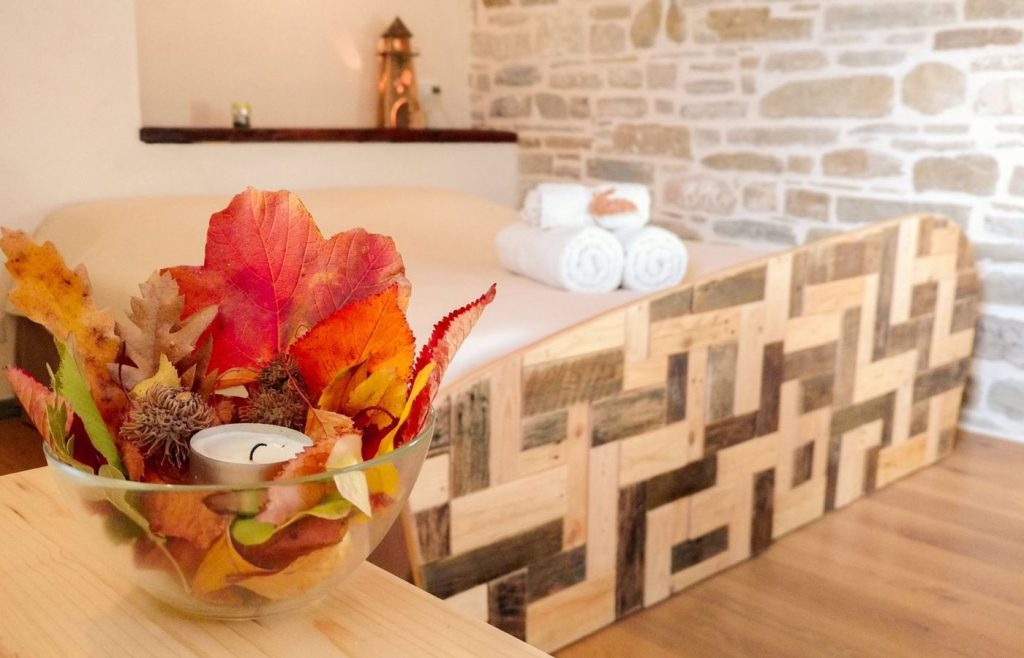
The interior furnishing of the Autosufficienza agriturismo is largely made of wood. Ivano, our carpenter and neighbor, delights in creating all kinds of forms from what the forest provides: from the projector holder to the door for the agriturismo’s electric meter; from the toilet‑paper holder and the half‑moon supports that hold the white quartz stones to the lamps and handles of the octagonal hall doors; from the faucet brackets to the mushroom‑shaped lights of the agro‑camping. If you wander through the spaces of Autosufficienza, perhaps during a guided tour, you’ll discover numerous creations born from local wood. We also frequently collaborate with Alessandro of Eco‑Spazi Design, who makes furniture from reclaimed wood such as pallets and driftwood. Another interesting example is the agro‑camping stairs: usually chestnut trunks are turned into planks, panels, or other cuts. The stump, the portion near the root, is wider in diameter and is discarded. Francesco, inspired by a trip to Patagonia, decided to build the agro‑camping staircases precisely with this waste piece. Beautiful and at the same time indestructible. Sawdust, the by‑product of the carpentry shop, and wood chips, obtained from pruning, are used as mulch in the garden to retain moisture and limit weed growth.
Examples of virtuous horticulture
In addition to wood chips and sawdust, we use freshly mown grass and aromatic herbs—the waste from distillation—as mulch in the garden. Our innovative recycling systems in the garden don’t stop there. With some of our neighbours we have a barter agreement: they graze their cattle on our extensive fields, and in return they give us manure that we use to fertilise the soil. Since these cows are fed entirely naturally, we are sure that our land is nourished only by what is good for it.
Another manure we use in the garden comes from our happy chickens: food scraps produced in the organic agriturismo end up in a designated area of the henhouse that they can access. The chickens eat these scraps, and the manure they produce is used to fertilise the garden soil. Those same garden vegetables then reach the plates of our guests—closing an entire cycle. Not to mention the delicious eggs from our chickens.


Grain: an Endless Wealth
Have you ever heard of the Autosufficienza’s pizza? It’s one of the aspects we’re most proud of here, mainly for three reasons:
- The oven in which we bake it was built during a workshop by mixing spring water, garden soil, and straw—the by‑product of wheat harvesting. To light the fire we use scrap wood.
- The dough is made with flour from local ancient grains, spring water, a sour starter, Italian organic extra‑virgin olive oil, and whole‑sea salt. The ingredients are organic and predominantly sourced from the territory or at zero‑kilometer distance. The pizza is cooked thanks to the combustion of wood from our forests.
- After the pizza is baked, we extract the embers from the oven and use the generated heat to bake bread. Those ashes are later turned into bio‑char, a compound useful for fertilising the garden soil, or alternatively into lye, historically employed in various ways for cleaning surfaces and objects.
The straw, the by‑product of wheat harvesting, was used to construct the octagonal hall and the agro‑camping buildings, as well as in the raw‑earth oven mixture.
Water Is the Basis of Life
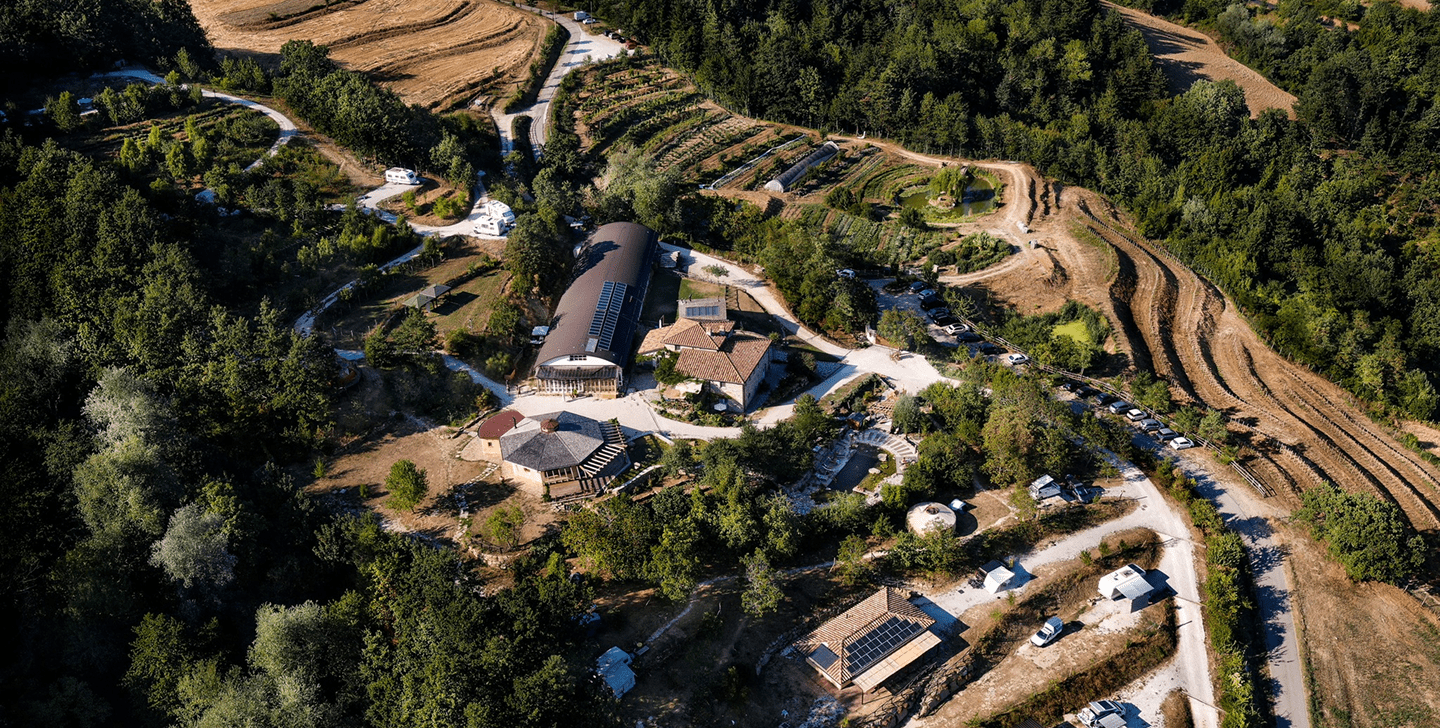
Many talk about a water crisis as if it depended solely on climate or external conditions. Few, however, ask how the water we have available is actually used. At the Autosufficienza Centre there are systems that allow rainwater to be released gradually into the soil without washing away the most fertile surface layer: we are talking about level ditches, or swales, and terracing.
Rainwater is also collected in cisterns that, once full, discharge into the downstream lake in the garden. The black water produced at the agriturismo or the agro‑camping is directed to a phytoremediation system where, thanks to the mechanical action of gravel and the microbiological action of plant roots, it is purified and stored in tanks for various uses, including irrigation.
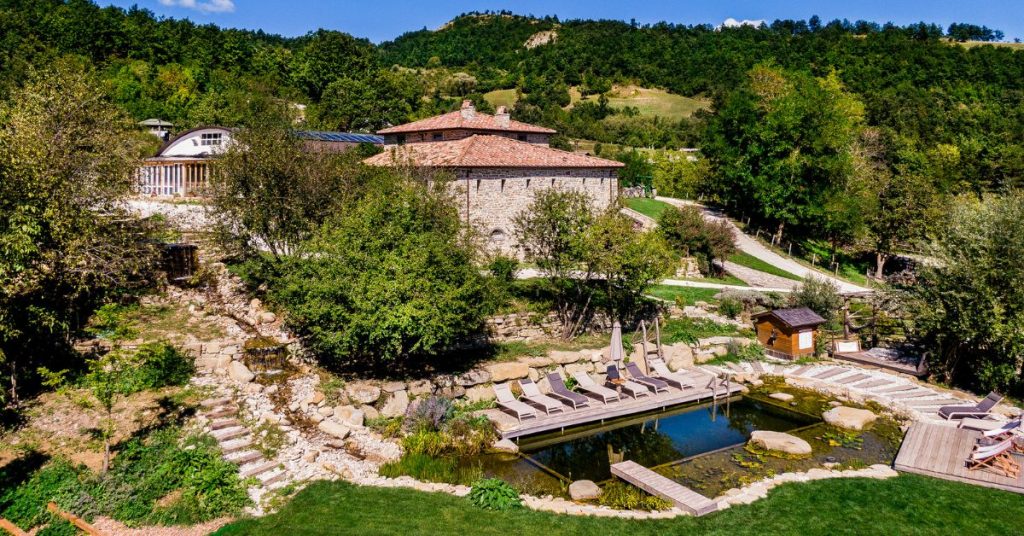
The natural swimming pool works the same way: the water used in the bathing pool is filtered by the first two tanks, creating an anti‑waste system that continuously recirculates the same water while keeping it clean.
If you find a stone, you find a treasure
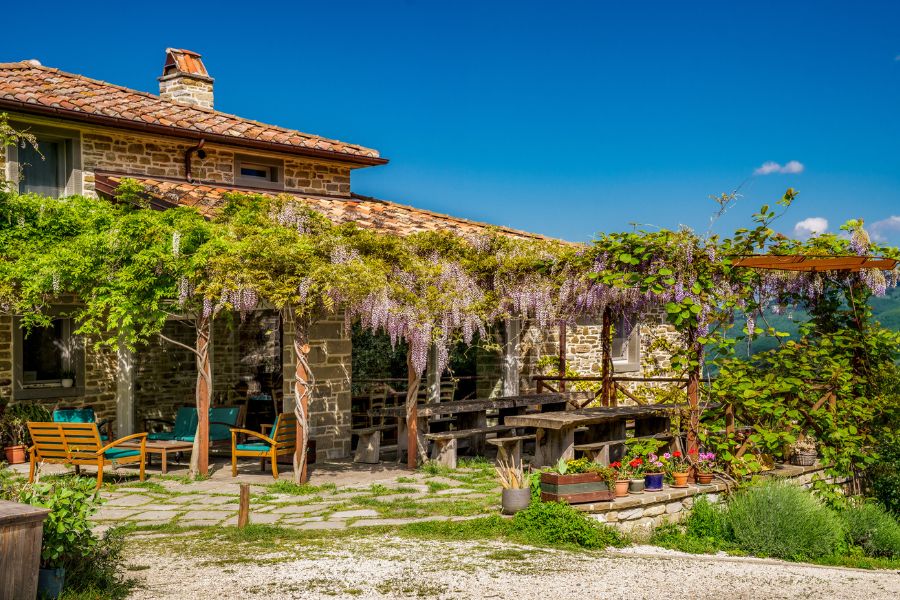
The ground on which the Autosufficienza agriturismo now stands was shaped thousands of years ago by a massive landslide. For this reason, every time we dig we encounter numerous stone fragments. This can be a limitation, as it hinders excavation, but it is also a resource, providing material that can be used in many ways. At Autosufficienza we have used the stone to build the main building, dry‑stone walls, and pathways.
The Most Ecological Structure in Italy
Very often, when I pass through the gate of Autosufficienza, I pause to observe everything that has been done over the years. What strikes me most is this sort of marriage between man and nature, an ancient yet modern union. It definitively proves that a different world, where caring for the earth is the primary foundation, is possible. Moreover, it is beautiful and elevates the intrinsic qualities of humanity. Today we can confidently say that the Autosufficienza farm stay is the most ecological hospitality structure in Italy: from dilapidated, polluting buildings and abandoned fields on the verge of reforestation, a paradise of biodiversity and beauty has been created. By starting from sustainability, we are, piece by piece, building the change we want to see in the world.
This article was featured in the magazine Vivi Consapevole 74 (september/november 2023).