


How to Deliver a More Humane World to Future Generations
Tommaso Carmenati | caretaker at the Applied Ecology Centre Autosufficienza
“Illness appears when people move away from nature. The severity of the illness is directly proportional to the degree of separation. If a sick person returns to a healthy environment, the illness often disappears.” — Masanobu Fukuoka
The Food forest, or edible forest, is a highly interesting agro‑forestry system because it offers clear and immediate insights into nature’s basic functioning. Let’s explore what it entails.
Have you ever seen anyone water or prune a forest?
A forest? Even imagining such a commitment is difficult. I doubt the current inhabitants of planet Earth could manage it.
Why does this happen? Within a forest, every plant, tree, and even every microorganism fulfills a specific function. Together they enable the ecosystem to maintain a constant equilibrium, which is why human intervention is unnecessary. Yet the organism produces the greatest amount of vegetative mass.
The Food forest operates in the same way. The only difference is that the various components that populate it have been deliberately studied and arranged by humans to ensure food production (hence the name “food”).
In contrast to a natural forest, the Food forest requires only minimal human intervention.
Because it functions as a systemic organism, it needs many years before it can express its fullest potential.
Food Forest, Intensive Bio‑Intensive Garden, Intensive Monocultures
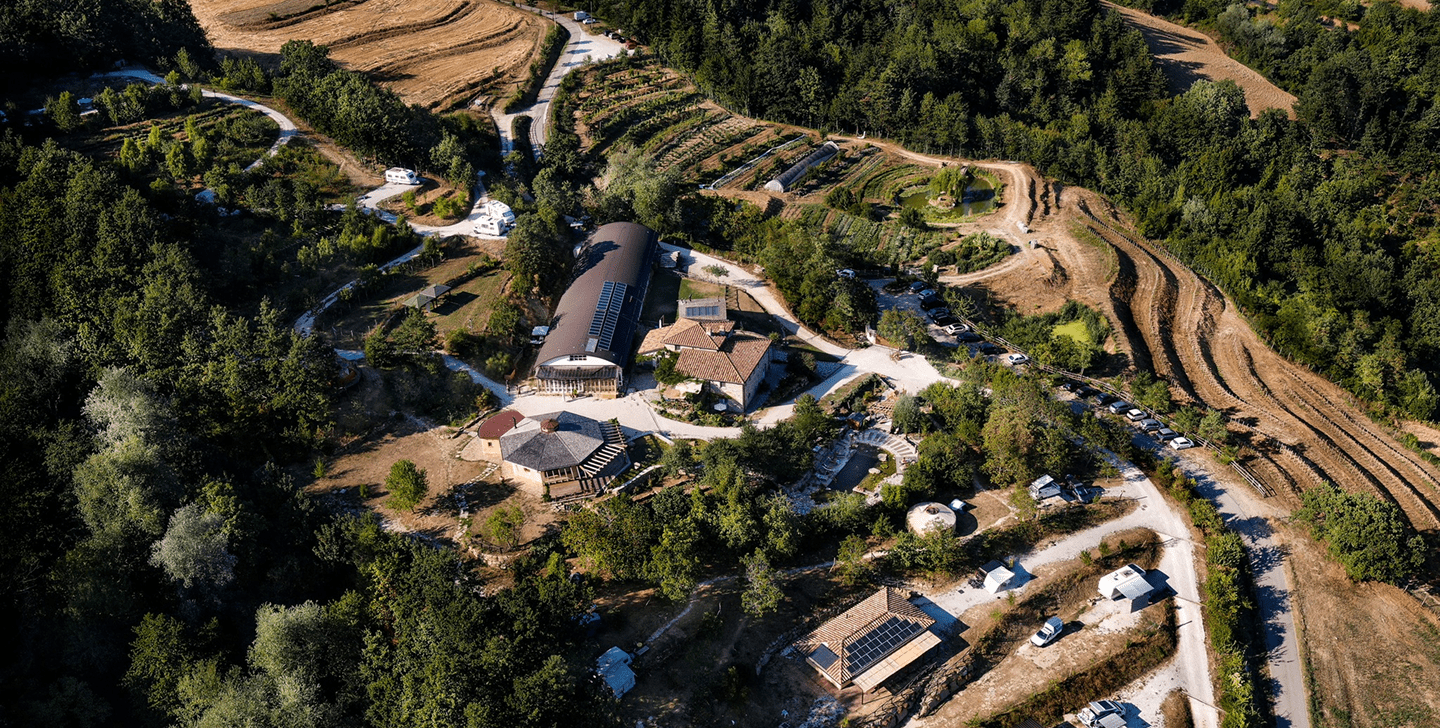
The agricultural system that supplies most of the food grown on the land of the Autosufficienza Farm is the intensive bio‑intensive garden, a plot where several crops are concentrated. No pesticides or synthetic products are used. Unlike the food forest, it requires constant labour.
Now let’s take a moment to consider intensive monocultures: vast expanses of a single fruit. Why is there a need for fertilizers and pesticides here?
A quick summary to clarify:
- Food forest: a few days of maintenance per year;
- Intensive bio‑intensive garden: constant labour;
- Intensive monocultures: human effort alone is insufficient; synthetic inputs are required.
The farther a system drifts from Nature, the greater the need for external intervention to counteract its attempt to restore balance.
Nature strives to restore balance because that condition allows it to thrive.
In the opening quotation, Fukuoka uses different wording to describe the same concept.
So, could it be that the problems afflicting modern society—from individual struggles to broader social phenomena—stem from the same root?
The loss of biodiversity at every level, from thought patterns to cultural practices.
A Sound, a Symbol Is Enough
I arrived at the Autosufficienza Centre three years ago and fell in love with the project because I grasped its essence: proving with concrete actions that another world is possible. A world built on collaboration—with nature and with fellow human beings. A world where the individual returns to serving the collective, not the other way around. A world in which difference is seen as an added value, just as in a food forest.
Coming from an urban background—the one most people label “normal”— I realise that until you experience this way of life directly, it is difficult to fully comprehend.
The greatest change the relationship with this place sparked in me was a progressive reconnection with nature—the true life, as I like to call it. Returning to fully living the seasons, their rhythm and cyclicity. Becoming aware of the journey that the food we eat undertakes, from soil to table, whether it is a kohlrabi, a chickpea, or a grain of wheat. Drinking spring water. Learning to recognise wild herbs and weaving relationships with them: medicine, food, beauty.
Running my hand along a hand‑crafted wooden handrail made from a tree that grew in the very earth you inhabit.
Witnessing the birth of a creature without resorting to any form of medicalisation.
Living alongside individuals who cooperate and devote their time to creating a better world, each respecting their own talent and passions.
Being able to observe the majesty of a star‑filled sky in all its splendour, with no trace of skyscrapers or light pollution. Often we believe that to effect change in our own lives we must understand something, study it. Sometimes, however, a single image, scent, or sensation is enough to make your life irrevocably different—because a breaking point occurs.
Returning Home
While leading guided tours at the Autosufficienza Center I often hear people’s testimonies.
Some have not attended a faló since childhood; others have never drunk water straight from a spring; still others have never planted a lettuce seedling. These details may seem trivial, but they are the gateways to a return to our true nature. Emotional experiences, once felt, remain etched inside us.
Visitors may arrive for a course, a short vacation, or even “by chance,” as I did. Then something unexpected happens: an inner spark ignites, a yearning to return. The destination may be unclear, but the impulse to go back—to what feels like a true home—emerges.
Drop by Drop
In 2023 the Centre will host more than one hundred twenty courses, most of them concentrated between April and November when we are officially open. This figure is not merely a milestone; it reflects our ongoing effort to inspire and engage the minds and hearts of those who wish to deliver a more humane world to future generations. By showing that an alternative world is genuinely possible, we invite everyone to join us, step by step, in building it.
Mother Teresa of Calcutta reminded us that “what we do is only a drop in the ocean, but if we didn’t do it the ocean would have one drop less.”
Let’s begin today; let’s begin now.
This article was featured in the magazine Vivi Consapevole 72 (March–May 2023).