


Most people who are passionate about a sustainable lifestyle in harmony with nature sooner or later come across Permaculture. And besides it’s difficult not to, since it’s a global phenomenon in continuous growth! Many of those who discover Permaculture experience what we could define as “the permaculture effect“, a sense of change or deep realisation, a will to break out of patterns and stop being part of the problem to instead start being part of the change. Where to begin? The answer is: in your own garden!
In case you don’t have a garden or a field, even just a balcony can be sufficient to be productive and help the planet make a difference, but also yourselves to maintain a connection with nature. If you don’t even have a balcony available, there’s always the possibility to take part in a community garden where you can get your space and dedicate yourself to your crops. Another possibility is to help design and maintain the garden of a friend who isn’t interested in gardening or horticulture. Where there’s a will there’s a way!
One of the important things learnt from permaculture is design, since permaculture is essentially a multidisciplinary design system. If you have taken part in a permaculture training course, you should be able to manage a basic design, but this isn’t the obstacle before which people stop. The main obstacles are taking the first steps, believing in oneself, believing one can do it and finally believing that it can work.
1. What is a permaculture vegetable garden
The first step for creating a permaculture vegetable garden is to understand what it represents for you. This may seem strange, but it’s the basis for creating any type of vegetable garden and you’ll surely have some idea of what you want to create. Having a defined project means having something to build and ensures that your ideas have a form and structure and are recorded on paper.
Design encourages resoluteness. Decide what you can and want to create now, not in a possible future, and then commit to doing it on a specific day or date, preferably immediately. If you postpone works and projects to a non-better specified future date, most likely you’ll never start them. Every vegetable garden designed according to the principles of permaculture, namely emulating the patterns present in nature, is by definition a permaculture vegetable garden. What needs to be decided at the beginning is the degree of adherence to permaculture principles in the vegetable garden design.
- The dimensions of the available spaces obviously condition the project which can go from a vegetable garden inside a container on a balcony to an entire acre covered with a food forest.
- You must decide “how much Permaculture” you want to integrate into the project, whether your vegetable garden resembles a traditional vegetable garden with some permaculture design features, or whether it’s a multi-level food forest project without constraints of any kind.

2. Permaculture principles: imitating nature
The next step is to decide which permaculture design principles you want to put into practice or at what level you want to highlight them. Moreover it’s important to choose how you will imitate nature in your permaculture project.
Below are some aspects to consider:
Soil protection – what does it mean?
- Mulches, plants that cover the soil, etc.
- Trying to keep the vegetable garden soil “uncovered” is against nature because nature tends to fill the space to protect the soil and in this sense pioneer plants do their best, even if they are often disparagingly defined as “weeds”.
- Bare soil is compacted by rain which degrades soil structure and at the same time washes away the most superficial layer.
- Not ploughing or working the soil helps to protect it. Working and turning over the soil destroys its structure and exposes the deeper layers to UV rays and heat which kill its biocenosis (the set of plant and animal life contained in it).
- Raised beds can help maintain the soil in good health provided their size allows reaching every part of it and one never walks on them. Trampling the soil destroys its structure, compacts it and prevents air and water from penetrating to the roots negatively affecting plant health and reducing their growth and productivity.
Rebuilding the soil – if your soil is rather “dead”, with scarce organic matter and humus, if it’s compact or somehow damaged, it’s necessary to remedy through soil rebuilding activities.
- Plants with taproots such as fenugreek or dandelion can be used to break up the soil.
- If absolutely necessary one can dig or lift the soil with a fork only once to loosen it and then cover it with mulch to protect it.
- Compost to spread on the soil can be used to bring the soil back to life and can be obtained through mound beds or, more quickly, through the layered mulch technique.
- Use green manure (plants grown and then mown) to generate a large quantity of biomass in order to mulch the soil. Plant remains decomposing will create humus. Broad beans are suitable for cold climates and bring nitrogen to the soil, as indeed do all other legumes (fabaceae family). At this link our article on green manure (link).
- Don’t walk on the raised bed soil, structure them in such a way that the soil doesn’t need to be worked and let earthworms dig the earth for you much more efficiently than any man or machine could ever do!
Plant stratification – vertical development.
- Plants in nature grow in a stratified structure, with the tallest trees forming a canopy, shrubs and herbaceous plants underneath, plants covering the soil in the lowest layer and which have cultivable roots and finally climbing plants that grow vertically. Replicating this structure allows making the most of space and increasing the productivity of a given plot of land. Here you can find our article on food forests.

Crop succession – the temporal sequence
- Nature favours plant growth to protect the soil, in fact as they disappear, plants are replaced by others. If transplanting of new plants is organised whilst the old ones are about to reach the end of their fruitful or productive life, one can plant in sequence to have harvests throughout the season, without leaving empty spaces in the vegetable garden or without having to wait a long time for plants to bear their fruits.
The edge effect – in nature the edges of each ecosystem, namely where the environment passes from one ecosystem to another, are the most productive places.
- If one intends to give further emphasis to the edge effect principle, one can opt for creating raised beds with curved edges, or for a large number of smaller rectangular raised beds.
Microclimate – groups of plants that grow together create differences in temperature, shade and humidity compared to the surrounding area, better favouring plant growth.
- Grow more plants together so they can protect each other from the elements (wind, sun, etc.). This will help them survive and create an even more resilient vegetable garden. Remember: a plant alone in a raised bed of bare soil is like a man standing in the middle of the desert under the scorching sun!
Vertical garden – plants don’t grow only on flat ground, but can also grow on vertical surfaces to make the best use of space.
Here are some ideas:
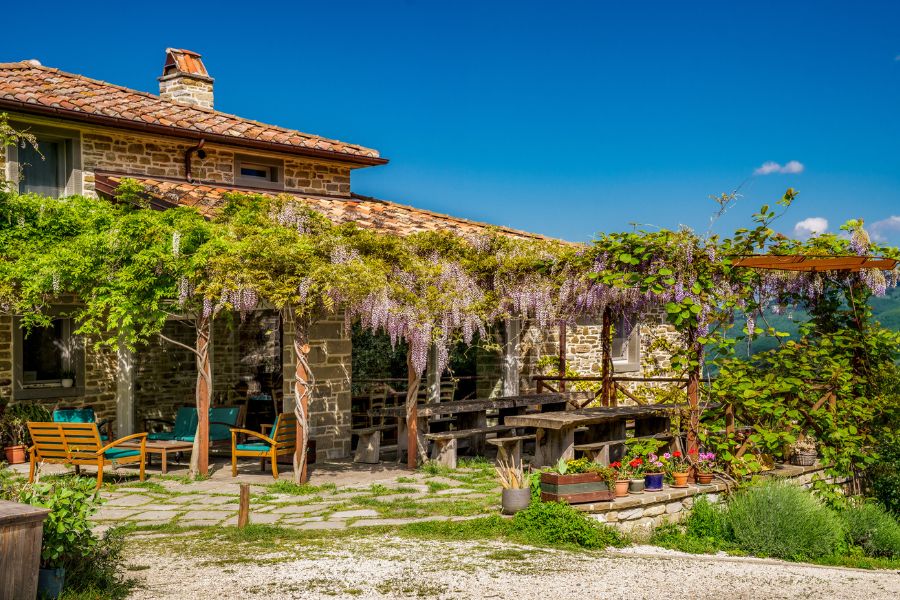
- Some climbing plants such as vines and kiwis can develop on pergolas, arches, fences and trellises.
- Cucurbits such as pumpkins, melons, winter melons, courgettes and luffa can grow vertically on a metal net (with meshes wide enough to insert hands) supported by poles.
- Espalier-trained trees can be grown along fences or in restricted spaces to maximise the productivity of large unused vertical spaces.
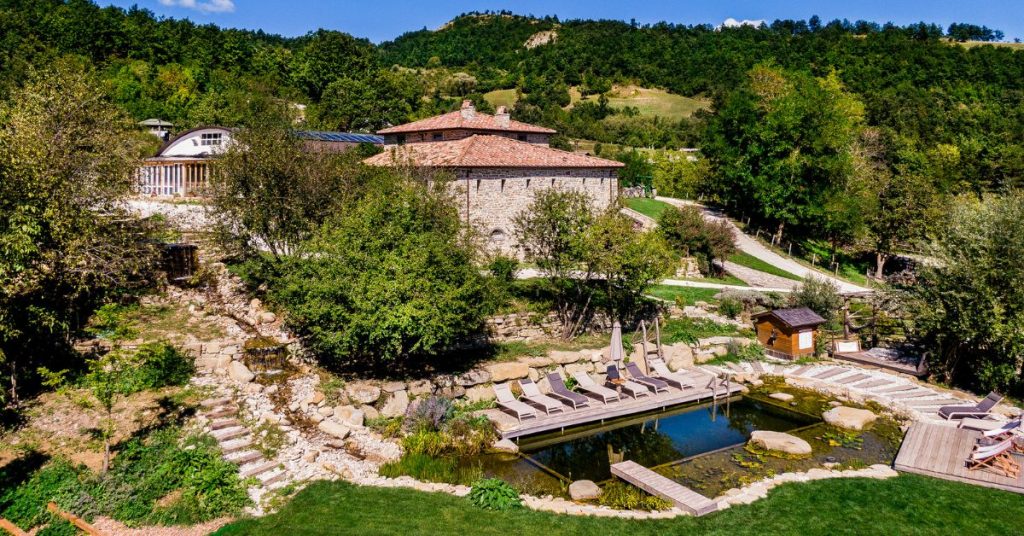
- Water gardens – aquatic ecosystems are the most productive of all and have many different functions.
- They can be used for cultivating edible aquatic plants such as water chestnut, arrowhead, lotus, Vietnamese coriander and many others.
- They can support aquatic or amphibian fauna such as fish and frogs.
- Large ponds favour the presence of ducks.
- A pond can be used to collect water from a phytopurification system which serves to purify and recycle grey water.

Monocultures, Polycultures and Companion Planting – nature favours biodiversity and a series of plants, associated with others in the right combination can help each other in growth and increase productivity.
- Companion planting can be used to stimulate growth and productivity, increase resilience to pests and diseases, hide plants or mask their smell so they are more difficult for pests to find, attract beneficial insects that serve as pollinators such as bees, or attract predatory insects of pests such as ladybirds, lacewings and hoverflies.
- Monocultures make plants more easily attackable by pests and prevent the use of companion planting or plant stratification. By mixing plants they are more difficult to find for you, but also for the pests that feed on them!
- Monocultures of annual plants require more work, more effort and the need to keep track of crops since planting one type of annual crop in the same place for more than one consecutive season leads to nutrient loss and the risk of diseases and pests. The choice falls on crop rotations, on accurate tracking of what grew where and when and what needs to be planted after, or one can undertake an easier and more natural approach, opt for polyculture and grow everything everywhere.
3. How to start
One of the biggest obstacles to overcome in building a permaculture vegetable garden is actually starting to build it. Often people agonise for months over design so it’s perfect and then get stuck at the moment of starting the project. The critical factor is motivation, overcoming the inertia of undertaking a big challenge. However, a big challenge appears easier when it’s broken down into smaller and more manageable parts. It’s easier to select small jobs to complete and the fact of completing each of them will increase your self-esteem and confidence in yourselves and will give the necessary impetus to tackle the next tasks.
The strategies to start are the following:
- Design big, start small – it’s important to try to understand what it is you ultimately want to create, break down all design aspects and then build a small part at a time.
- Determine the project size – whether it’s a balcony vegetable garden or a food forest, get a clear idea of how big the vegetable garden will be and also take its maintenance into consideration. A fully developed food forest will need much less maintenance than an urban vegetable garden. This is evident if one thinks about root space, water availability, plant size, etc. Remember that the forest doesn’t need to be watered, pruned or fertilised!
- Determine the critical elements of the project – these can include: water, wind, sun, vegetable garden orientation, proximity to the house, plant arrangement according to particular requirements. Moreover one must remember to plant in the right season.
- Modular design – a very efficient way to build a large vegetable garden is to start small, use easily replicable units (including companion plantings) to extend the vegetable garden to the desired size.
- Establish priorities based on element size – a crucial priority in construction is to place in the project first of all the large-sized elements and then develop the others around them. For example, in a food forest project, trees must be considered first and then the irrigation system must be installed. Then progressively smaller plants are planted around the trees and irrigation pipes. The smallest elements such as ground cover plants are planted last. The logic of this way of proceeding is that one cannot dig holes large enough to contain a tree in raised beds full of small plants and installing an irrigation system in an already planted raised bed is one of the most burdensome and time-consuming practices if one wants to try not to damage all the plants in the raised bed…


In summary, managing the work of building a vegetable garden from scratch by breaking it down into small manageable parts, one raised bed at a time, with a complete project to guide every effort, makes the experience less daunting than it may initially appear. It’s easier to start something that looks more like a molehill than a mountain! Once you’ve successfully completed your permaculture vegetable garden project, you’ll look back and be glad you made this effort. If you’ve taken a permaculture course, I urge you to take this step and put into practice what you’ve learnt. Nothing strengthens knowledge better than its practical application. And besides, it’s by doing things that we learn them best!
Article translated from https://deepgreenpermaculture.com/diy-instructions/starting-your-permaculture-garden/