


Permaculture teaches us to manage water naturally and intelligently, to stop the advance of deserts
It was 2011 when I decided to go visit the Krameterhof in the Lungau region in Austria. I had been struck by the vision of a documentary in which they talked about Sepp Holzer, the rebel farmer who had transformed the family farm into a natural paradise building an impressive system of 80 lakes and terraces on steep land from 1100 to 1500 metres altitude.
Through the website I got the contacts and asked for information for a visit. They gave me availability to bring an Italian group to the farm with translation and so I set myself in motion. At that time there were no books in Italian by Holzer and no Italian website that talked about this character, despite this, I soon gathered twenty people eager to leave. Having arrived on site it was Andreas, Holzer’s son, who welcomed us: for four days we alternated farm visits with theoretical lessons and visions of Sepp’s permaculture projects.


What appeared before my eyes I will never forget. At the Krameterhof I understood that it’s possible to do agriculture and at the same time create incredibly beautiful landscapes even in impervious areas of the earth where, at first sight, every effort might seem vain. I understood that knowing how to manage water intelligently and naturally can change the world and above all that it’s possible to bring life back to deserts. The really great thing about Sepp Holzer is that after creating a paradise on his estate in Austria, he began, as a consultant, to create paradises in every region of the world obtaining incredible results even in deserts, one of the biggest plagues of our time.
After creating a paradise on his estate in Austria, Sepp Holzer began, as a consultant, to create paradises in every region of the world
Reversing desertification is possible with permaculture
The process of global desertification is so dramatic that, according to the UN, at world level it has already determined the loss of a fifth of arable areas. The rainforests of South America or Indonesia are transforming into desert more quickly than one manages to study their animal and plant species. Even those that today are deserts, in ancient times were fertile regions: the Sahara was a green savannah in which human beings managed to live well. In the desertification process vegetation and soil life become impoverished, the soil dries out, the water table lowers and erosion of fertile land intensifies until humus disappears completely and only sand remains. Cultivation becomes increasingly difficult and farmers abandon the land.
Even in Italy this dramatic situation follows its own course. Summer drought increases. Deforestation, tree die-off and monocultures decrease the soil’s water storage capacity. Vegetation, decimated, can no longer provide sufficient shade to the soil, which, at this point, is hotter than rainwater: if it rains, humidity no longer penetrates deeply, but forms droplets on the surface. The soil hardens. Heavy winter rains can no longer permeate the earth and wash away humus transporting it to valleys, rivers and the sea. What remains is sand and stones. Trees die, woods catch fire, farmers abandon fields, entire regions become depopulated. Thus the ghost villages of the South are born. For Sepp Holzer stopping all this is possible and on many occasions, as in the Tamera ecovillage in Portugal, he has demonstrated it with facts.


The Tamera ecovillage and halting desertification
In March 2007 Sepp Holzer was invited to Portugal for a consultancy at the Tamera ecovillage. The challenge was: in an arid landscape tending towards desertification like southern Portugal, how can one create a model of healthy fruit and vegetable production for three hundred people on a surface of 150 hectares? From the beginning Holzer’s proposal was to create a water landscape of at least ten lakes and retention basins. In these arid territories, the most important thing is to prevent desertification and create sufficient retention basins for rainwater. For the first lake, at the narrowest and deepest point of the valley, an embankment with an arched course was erected, shaped to the landscape. To create it a ditch 5 metres deep was dug and a thick waterproofing layer of silt was buried in it: the insulating layer which absolutely must be watertight. At the sides, this sealing core extended right into the slopes, and at the end it had been completed with an embankment on both sides. The final slope should not have been greater than 1:2, because only in this case can vegetation grow on it. The escarpment was planted. The material for the embankment was taken from the area of the future lake. At one point of what would become the bed, the excavations created a basin, which in the case of Tamera’s “Lake 1” is 12.5 m deep. The different soil layers obtained with excavation operations were not to be mixed, but were immediately separated: for the waterproofing layer the material from the silt layer was needed, whilst humus was not to end up in the embankment, but would be used later for cultivable surfaces.
Even in Italy desertification dramatically follows its own course
Work on the first lake concluded in autumn 2007, and winter and spring rains accumulated inside the embankment on natural ground. At first the water filtered into the subsoil, to replenish the invisible underground reserves. Although two extremely dry winters followed, the lake formed anyway, and little by little it covered the landscape. Despite the porous slate ground, additional waterproofing wasn’t necessary. “Lake 1”, which measured several hectares, was followed in subsequent years by other decentralised retention basins.

Meanwhile the fruit trees that had been planted on the terraces have had lush development, as have the berry bushes: at their feet a great variety of vegetables and salads grow. On the terraces which reach 18 m in width and are crossed by paths, a magnificent edible mixed broadleaf forest will develop. The terraces are usable as vegetable gardens and gardens, but also as green spaces and as paths for excursions and horse rides. On the downstream escarpments pergola-covered pathways can also be created passable with agricultural machines or carts for harvesting: it’s possible without difficulty if one doesn’t prune the high branches of trees, but lets them grow and regulates them only if necessary. Then, even with the strong summer heat and temperatures reaching 40°C, a sheltered microclimate is created, with a wind tunnel that provides ideal conditions for growing vegetables and medicinal herbs.
Thus it’s possible to design the terraces surrounding the lake as places of great beauty and usefulness. It’s completely logical that terrace crops benefit from the lake: solar radiation, soil water saturation, greater dew formation and air humidity have very positive effects on plant growth. In intensive vegetable crops, which in summer must be irrigated anyway, drip irrigation tubes and ditches are used, and water is pumped directly from the lake. Water bodies can be highly profitable agricultural surfaces, sometimes even more so compared to cultivated fields. They can be exploited for fishing, aquatic plant cultivation, organic farming of poultry and Indian buffalo, but also for responsible tourism and sports activities. As is evident, today the lakes are already indispensable: it’s difficult to imagine what Tamera would be like without its lakes and ponds.
Sepp Holzer at Autosufficienza Farm
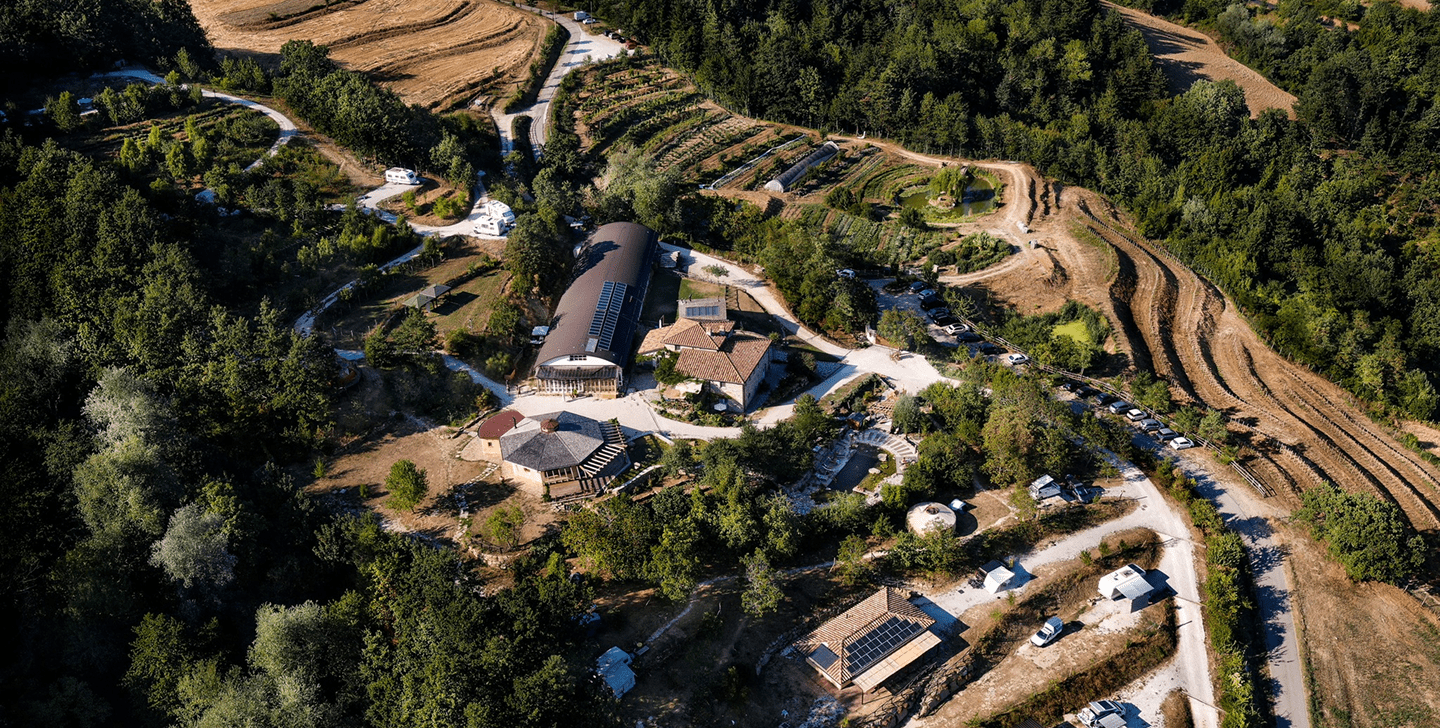
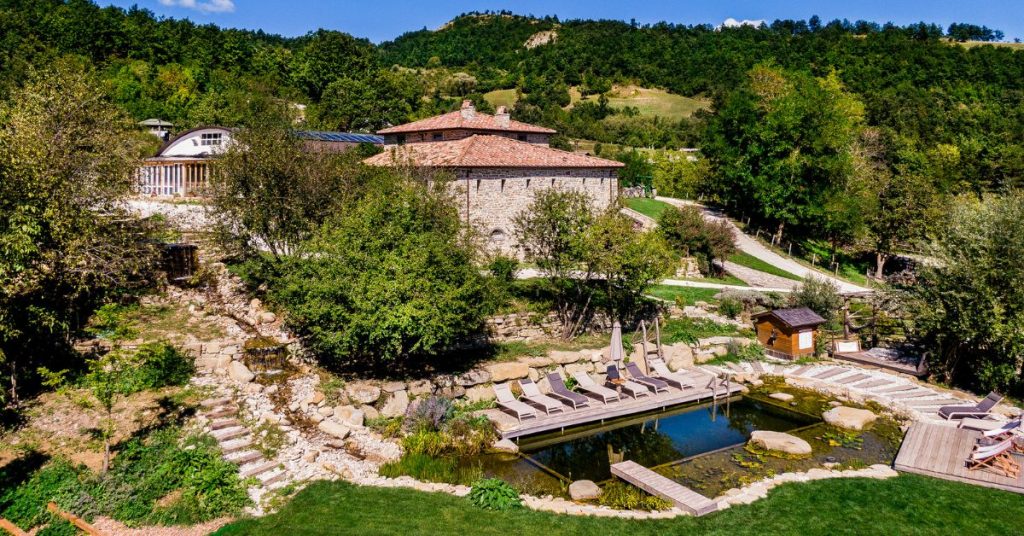
After visiting the Krameterhof and after viewing spectacular projects like that of Tamera, I decided to have Sepp Holzer’s books translated and published by Filo Verde di Arianna and to invite him to Autosufficienza Farm so that part of his immense knowledge could also influence the Romagna territory. This was able to happen in 2016 when Holzer, after 3 days of consultancy at Autosufficienza Farm, held a 4-day permaculture course which thirty people attended. Obviously the inputs were many and soon Autosufficienza Farm too will have its lakes and its paradise.
SUGGESTED BOOKS: